

Rojava Is the Red Line – It’s Being Crossed
Rosa Burç researches Kurdistan. Here, she explains why recent attacks on Rojava aim to erase the Kurdish political subject – and what this reveals about the new order in Syria.

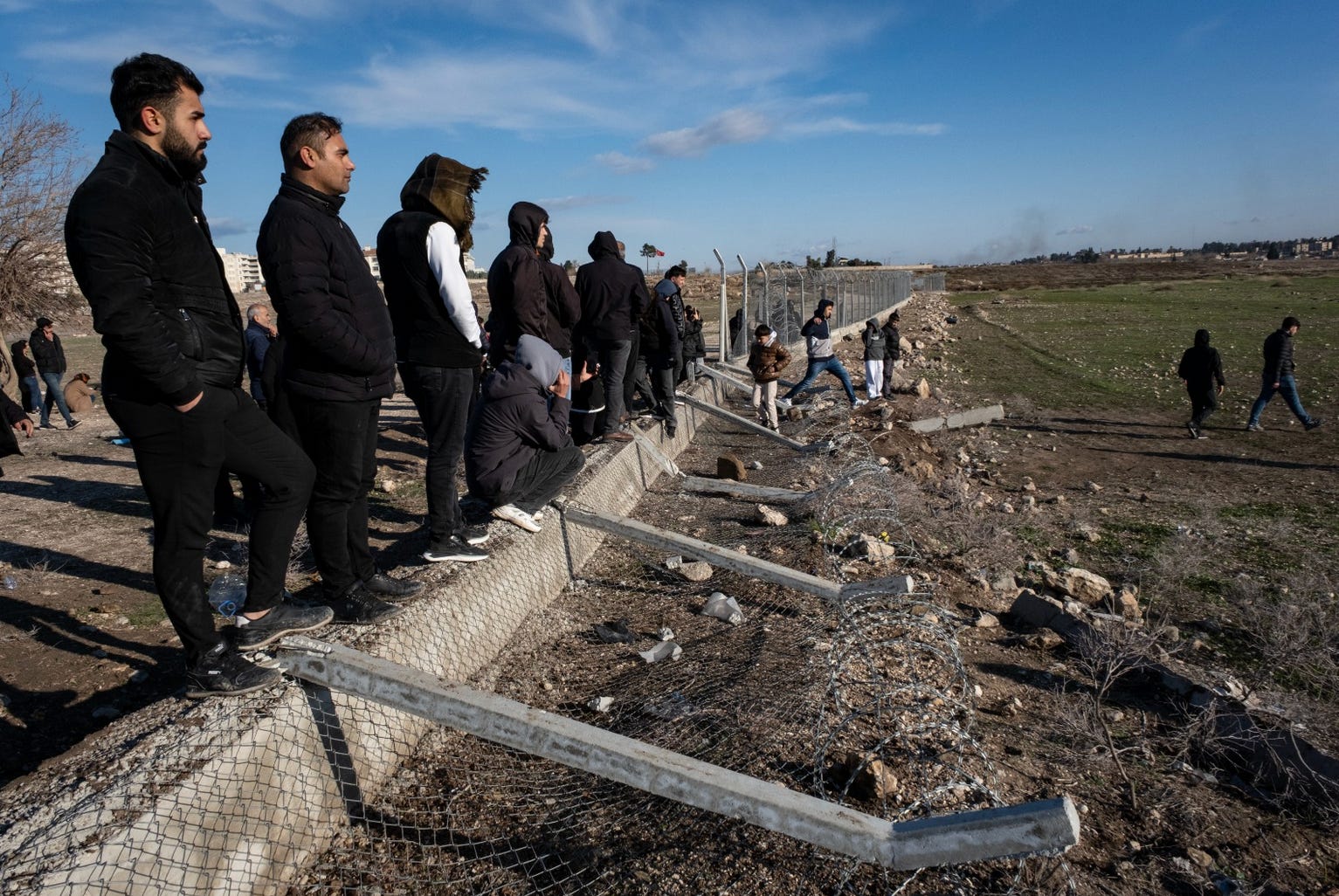
In a photograph by Kurdish photojournalist Refik Tekin, civilians stand on the border wall between Nisêbîn and Qamişlo. Sections of barbed wire have been torn down, and people look from Turkish territory into Syrian territory – from North Kurdistan into West Kurdistan. These border protests are a transnational response to the brutal attacks by Syrian government militias, first on Kurdish neighborhoods in Aleppo and then across all of Rojava.
Since the security agreement reached in Paris on January 8 between the Syrian interim government, Israel, and the United States, Islamist HTS militias have been moving through Rojava. They have deliberately targeted humanitarian infrastructure and entire cities. In Kobanê, electricity and water supplies have been cut; across the region, people have been displaced and women abducted. Beheadings and public executions have been reported. In Raqqa the flag of the Islamic State has been raised again for the first time in ten years.
The recent violence is not coincidentally reminiscent of earlier phases in Kurdistan. An official Syrian decree cites the Qur’anic Surah al-Anfal and calls for the “conquest” of Kurdish territories. The current attacks on Rojava unmistakably echo both the Anfal campaign carried out by Iraq’s ruler Saddam Hussein and the reign of terror imposed by the Islamic State.
Against this backdrop, Kurdish mobilization for Rojava across borders is more than a symbolic gesture. It reflects a shared awareness of an existential threat. For Kurds everywhere, it is clear that this is not just about Rojava as a political project, but about defending the very possibility of a Kurdish future amid shifting geopolitical realities.
Positions that are otherwise divided now converge: from advocates of Kurdish nation-statehood to proponents of democratic confederalism. This unity cuts against the persistent myth of “Kurdish fragmentation.” The mobilization for Rojava shows that unity need not rest on ideological consensus alone. Here, it seems to be enough to grasp the aim of the attacks on Rojava: the imposition of an order in which a Kurdish political subject is no longer meant to exist.
All the more striking, then, is how this escalation is being discussed. Kurds are suddenly cast as provocateurs, accused of refusing to submit to the Syrian state’s integration project. They are labeled “occupiers,” despite the fact that these are historically Kurdish settlement areas and that their political project is grassroots-democratic and multiethnic in orientation. The legitimacy of the Kurdish-led Syrian Democratic Forces is retroactively narrowed to their role in the fight against the Islamic State.
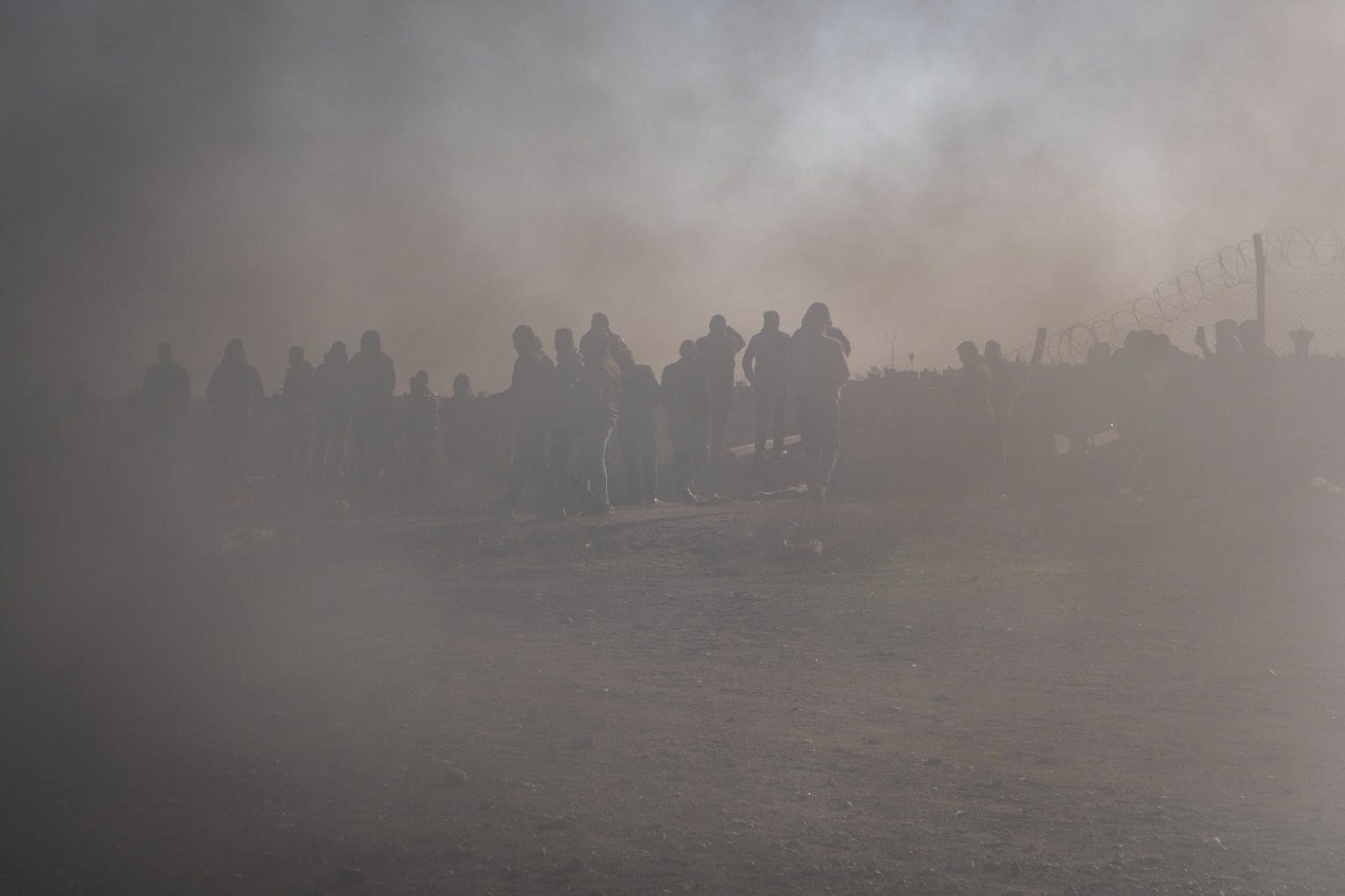
This shift is no accident. The post-Assad order in Syria derives its legitimacy not from social plurality or democratic process, but from the language of the state itself. The Islamist HTS militia governs de facto, manufactures the symbols of a new nation-building project, refashions itself into a state power, and is treated as a diplomatic interlocutor.
Ahmad al-Sharaa, once listed on international terror watchlists, is now courted as a statesman, while Kurdish demands for self-administration are dismissed as mere inconvenience. Writing in the online magazine The Amargi, the Kurdish author Bachtyar Ali recently argued that Rojava represents an antifascist model because a different language of life emerged there – one opposed to annihilation, homogenization, centralism, and subordination. The border protests are its current political expression. Rojava is the red line – and it’s being crossed.
This is a translated version of an article originally published in Neues Deutschland.
 | A guest post by
|